
Senegal: Turning Oil and AI Into Human Capital
By Marie Castelli
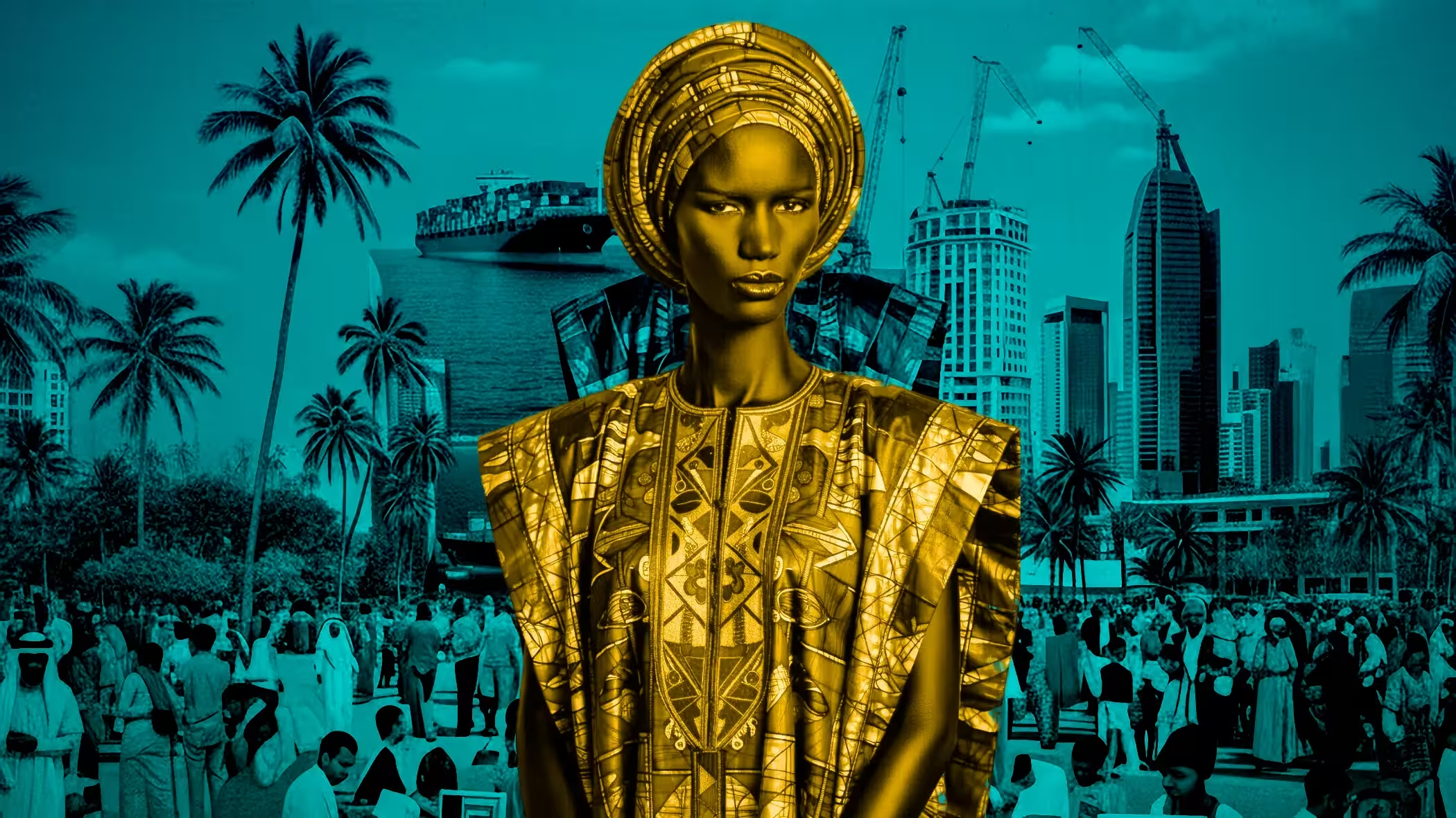
A new hydrocarbon producer facing the training challenge
Dakar
On the Dakar waterfront, where the Atlantic Ocean laps the shores of the Cap Vert peninsula, a transformation is underway. A hundred kilometers offshore, the Sangomar oil field has been spewing its black gold since June 2024, placing Senegal in the very exclusive club of African hydrocarbon-producing nations. In 2024, the country extracted 16.9 million barrels, far exceeding the initial target of 11.7 million. The revenues generated, approximately $950 million, sent growth soaring to 6.9%, compared with 4.3% the previous year. The liquefied natural gas from the Greater Tortue Ahmeyim project, shared with neighboring Mauritania, began flowing on December 31, 2024. President Bassirou Diomaye Faye, elected in March 2024 on a pan-Africanist and sovereignist platform, promised that these riches would be well managed. During a visit to a school in the Dakar suburbs shortly after the first extraction, he assured pupils that an intergenerational fund had been created for them and future generations.
But beneath the veneer of impressive growth figures lie darker realities. Some 37.5% of the Senegalese population, or nearly 7 million people out of 18.9 million inhabitants, live below the national poverty line. In rural areas, this proportion rises to 53.3%. Broad unemployment affects nearly 19% of the working population, and youth unemployment reaches 20.3% according to the African Development Bank. Even more worrying, approximately 38% of children aged 6 to 16 are outside the school system, according to the sectoral education analysis published in 2025. The Minister of Youth, Sports and Culture, Khady Diène Gaye, summed up the situation in the columns of L'Observateur at the end of 2024: "There is unease among young people. And this deserves the elaboration of public policies sensitive to the multiple concerns of youth."
The Senegalese paradox is striking. While billions of dollars pour into the economy through foreign direct investment, which reached nearly $3 billion in 2024, or 15.5% of GDP, the country struggles to transform this windfall into opportunities for its plentiful youth. The ruling tandem formed by President Faye and Prime Minister Ousmane Sonko faces a dilemma familiar to rentier economies: how to avoid the resource curse and use oil wealth to build sustainable and inclusive development?
The temptation of renegotiation
True to his campaign promises, Bassirou Diomaye Faye launched a comprehensive audit of the extractive sector as early as April 2024. He committed to renegotiating 27 contracts in the hydrocarbon and mining sectors, deemed too unfavorable to Senegal by the new authorities. "The contract renegotiation process is following its normal course. The results at this stage are more than satisfactory," the president declared in April 2025, during a speech to the nation. But nearly a year after the launch of this commission, the concrete results remain fuzzy. Ousmane Sonko, the prime minister, defended this position by evoking the example of Kédougou, a region rich in gold, iron and marble: "I can tell you here that 27 mining contracts will be studied, reviewed and renegotiated. The Government is working to make Senegal a steel and metallurgy hub."
This approach is not without risks. Oil majors such as BP, Woodside Energy and Kosmos Energy have invested massively in the country based on contractual stability. An audit conducted by the government task force estimates that in the event of failed renegotiations, the shortfall could reach between $200 and $300 million over 25 years of exploitation, a relatively modest sum given total investments. Investors nervously observe this willingness to revise, fearing a precedent that could tarnish Senegal's attractiveness for future projects.
Yet the government has little room for maneuver. With public debt hovering around 100% of GDP, inherited from the previous Macky Sall regime, public finances are under strain. President Faye denounced as early as September 2024 "an uncontrolled drift in the wage bill, an explosion in debt and its interest, as well as totally chaotic subsidy management." In this context, every dollar counts. The 595.5 billion CFA francs generated by oil in 2024 represent a breath of fresh air, but are far from sufficient to finance electoral promises: reducing the cost of living, fighting youth unemployment, improving public services.
Massive investments, but few creators of skilled jobs
The influx of foreign investment into Senegal is undeniable. Beyond hydrocarbons, the country is attracting major infrastructure and energy projects. The deep-water port of Ndayane, developed by DP World with an investment of $1.2 billion, is expected to create more than 1,800 jobs during construction and generate, according to projections, up to 2.3 million indirect jobs in the Senegalese economy by the time it is fully deployed. The Just Energy Transition Partnership, led by the European Union, France, Germany, the United Kingdom and Canada, is mobilizing €2.5 billion over three to five years to help the country reach 40% renewable energy in its installed electrical capacity by 2030.
But these figures mask a more nuanced reality. Oil and gas projects, highly capitalistic, directly employ relatively few people and require cutting-edge technical skills: engineering, geosciences, industrial maintenance, cybersecurity, data analysis. Without an aggressive training policy, the bulk of added value and skilled jobs will go to expatriates or foreign subcontractors. The port of Ndayane will require specialists in logistics, customs, analytics and port cybersecurity. Renewable energies demand technicians trained in the installation and maintenance of solar panels and wind turbines. The country faces a classic mismatch between labor market supply and demand.
A report by the International Labour Organization notes that more than 90% of young Senegalese work in the informal sector, characterized by strong job precariousness, both in working conditions and remuneration. According to a university study on employability in Senegal, "massive informal employment and high youth unemployment are partly explained by the poor alignment of youth training with market needs." The informal sector, despite all its flaws, proves more able to recruit young people at the end of their apprenticeship than the formal economy, incapable of absorbing the growing mass of job seekers.
Babacar Kane embodies this reality. Holder of a literary baccalaureate for three years, he runs through the streets of Dakar selling small trinkets to motorists. "No longer able to stay at home doing nothing, I convinced my uncle to lend me 20,000 CFA francs to buy small things that I resell," he explains in a testimony collected by the United Nations. "Sometimes generous drivers who see me running behind their cars give me a little change, but it's very hard for me. I really like making little films with my phone and sharing them with my friends. If I could, I would do training to make films."
The New Technology Deal: artificial intelligence as a lever
Faced with these challenges, the Senegalese government is betting on a bold strategy: making digital transformation and artificial intelligence a development lever. On February 24, 2025, President Faye officially launched the New Technology Deal, an ambitious strategy endowed with 1,097 billion CFA francs, or approximately $1.7 billion, over the period 2025-2029. "This strategy is the fruit of a clear and voluntarist vision whose objective is to raise Senegal to the rank of sovereign and prosperous nations, by making digital technology one of the engines of our social and economic transformation," the president declared at the launch ceremony. "This project is at the heart of the National Transformation Agenda, Senegal 2050, which sets the milestones for a society anchored in strong values and turned toward inclusive and sustainable development."
The program aims to train 100,000 graduates in the digital field by 2034, to bring the connectivity rate to 95%, and to create more than 500 labeled startups, with the emergence of 50 African champions. Artificial intelligence occupies a central place in this vision. Alioune Sall, Minister of Communication, Telecommunications and the Digital Economy, puts it bluntly: "Artificial intelligence is a revolution that we must seize. It is not only about consuming technologies from elsewhere, but creating our own solutions, adapted to our realities and our needs. Senegal must be a major actor in this transformation."
The New Technology Deal is structured around 12 priority programs broken down into 50 flagship projects. Among them, the "AI & Digital Factory" program aims to make Senegal a center of excellence capable of producing, using and exporting technologies and solutions in artificial intelligence, cloud computing, cybersecurity, virtual reality, gaming and robotics. The government plans the creation of supercomputers, data centers and a sovereign cloud to reduce dependence on foreign technologies. A regulatory framework is being developed to guarantee data protection and algorithmic transparency.
This strategy is in continuity with the National Strategy and Roadmap on Artificial Intelligence to the 2028 horizon, developed through a participatory process mobilizing public, private, academic and citizen actors. The stated vision rests on four pillars: making AI a catalyst for the Plan Sénégal Émergent to strengthen productivity and create skilled jobs; using AI as a tool for social and environmental progress to improve access to care, education and justice; anchoring itself in an African tradition of solidarity and interdependence to become a central actor in regional cooperation; and guaranteeing responsible AI governance in line with international standards.
The concrete applications are multiple. In the agricultural sector, which employs a large part of the rural population, AI should make it possible to predict yields, optimize irrigation and better manage natural resources through smart sensors and advanced analysis tools. This transformation aims not only at increased productivity, but also at better resilience in the face of climatic challenges, particularly acute in the Sahel. In cities, intelligent signaling systems could adapt in real time to traffic density, thus reducing Dakar's chronic traffic jams and improving road safety. Telemedicine, computerized patient records and the use of AI for early disease detection promise to transform access to care in a country where health infrastructures remain insufficient.
Digital education: the missing link
But the most crucial element of the New Technology Deal concerns education. On January 2, 2025, the Minister of the Digital Economy, Alioune Sall, and his counterpart from National Education, Moustapha Mamba Guirassy, unveiled the digital education strategy 2025-2029, endowed with 130 billion CFA francs, or $206 million. This initiative aims to modernize the education system by integrating information and communication technologies, notably artificial intelligence. A training program is planned for 105,000 teachers in digital technology and AI, while interactive learning platforms and virtual laboratories are to be deployed in schools.
This strategy intervenes in an alarming context. With 38% of children aged 6 to 16 outside the school system, Senegal faces a major educational crisis. UNESCO deplores an educational poverty rate, defined as the inability to read and understand a simple text at age 10, of 86% for sub-Saharan Africa. In Senegal itself, the quality of teaching is often mediocre, infrastructures aging and the pupil-teacher ratio high. The education budget for 2026, approved at $1.75 billion, represents a significant increase, but remains insufficient to fill the crying needs for classrooms, school textbooks and qualified teachers.
The government has launched several initiatives to reintegrate out-of-school children. A $27.4 million plan aims to reintegrate 15,000 children outside the school system. Programs such as "Each Young Person, A Trade" aim to train 15,000 young people nationwide in 2025-2026 through short, free courses in promising sectors such as sewing, crafts and technical trades. The Vocational Training and Integration Project, financed by the Mastercard Foundation with 1.8 billion CFA francs and implemented by EDC-Senegal, aims to train 181,350 young people by 2027 in key sectors such as agriculture, the green and blue economy, digital technology and innovation. The Minister of Employment and Vocational and Technical Training, Amadou Moustapha Njekk Sarré, has emphasized the importance of these initiatives in a context where the National Statistics Agency estimates the broad youth unemployment rate at 27%, women being the most exposed.
But these efforts remain drops in an ocean of needs. A study conducted in 2025 among trainers in two pilot vocational training establishments in Senegal reveals that 57.9% of trainers fear that the use of AI will diminish learners' skills, while 30.3% raise problems of ethics and integrity. The level of integration of digital skills in training programs remains low, at only 27%. Digital infrastructures are unevenly distributed, rural areas remaining largely disconnected despite promises of satellite antenna deployment in 2026 to extend internet access.
International partnerships: a lifeline
Aware of the magnitude of the challenge, Senegal is multiplying international partnerships. In October 2024, the Bill and Melinda Gates Foundation signed a $10 million agreement with the Senegalese government to accelerate the New Technology Deal, with a particular focus on digital education and health. The Pasteur Institute of Dakar is developing AI solutions for disease surveillance and health crisis preparedness in West Africa. UNESCO is conducting South-South cooperation to develop AI skills in Africa, with Senegal as a pilot country. Summer schools such as the Dakar Machine Learning Summer School train African researchers and students in the latest advances in artificial intelligence.
The private sector is also getting involved. Ericsson, in partnership with operator Free and the Ministry of National Education, is collaborating to improve the digital education ecosystem. Sonatel, Senegalese subsidiary of Orange and leader in telecommunications in the country, regularly presents its responsible AI solutions at SALTIS, the Senegal International Salon of Algorithms, Sciences, Technologies and Innovation, which has become an unmissable event for digital actors in West Africa. The company uses AI to automate customer interactions, secure Orange Money transactions and contribute to public services through the responsible exploitation of anonymized data.
But these initiatives, as promising as they are, run up against structural obstacles. Internet penetration in Senegal remains limited, particularly outside urban centers. Geographic inequalities are glaring: while Dakar and Thiès benefit from decent connectivity, rural regions remain largely cut off from the digital world. The cost of internet access and computer equipment remains prohibitive for the majority of the population. Frequent power cuts complicate the use of digital technologies. Language constitutes another brake: most online educational content is available in French or English, de facto excluding a part of the population that speaks mainly Wolof or other local languages.
The resource curse revisited
Senegal is not the first African country to face the dilemma of oil rent. Nigeria, Angola, Gabon and Equatorial Guinea have all discovered significant hydrocarbon reserves that enriched elites without necessarily improving the lot of the population. Corruption, bad governance and the absence of economic diversification have transformed the blessing of natural resources into a curse. Senegal, fortified by its relatively stable democratic institutions and tradition of participatory governance, hopes to avoid this trap.
President Faye has insisted on transparency and good governance of oil revenues. During a council of ministers in June 2024, he announced the holding of a session of the Strategic Orientation Committee for Oil and Gas whose composition would be revised, with the objective of updating the national development and exploitation strategy for oil and gas resources while ensuring the proper distribution and framing of revenue management. Prime Minister Sonko specified that artificial intelligence would be put to use to improve the management of these resources, notably in terms of quantitative surveillance, production security and environmental risk prevention.
But good intentions are not enough. Public debt close to 100% of GDP considerably limits budgetary room for maneuver. The rating agency S&P Global downgraded Senegal's rating to B- in October 2024, reflecting concerns about debt sustainability and the government's capacity to meet its financial commitments. In this context, the temptation to prioritize short-term spending to the detriment of long-term investments in education and training is real.
The real question is whether Senegal will manage to transform its oil boom into human capital. The example of Norway, which used its oil revenues to build one of the world's largest sovereign wealth funds while maintaining a world-class education system, shows that it is possible to avoid the resource curse. But Norway already had strong institutions, an educated population and a tradition of good governance when oil was discovered in the North Sea in the 1960s. Senegal starts from much further back.
Artificial intelligence is not a magic wand
The Senegalese government's enthusiasm for artificial intelligence is understandable. This technology offers unprecedented possibilities to accelerate development, improve public service efficiency and create new skilled jobs. But it is not a miracle solution. AI cannot replace teachers, classrooms and basic infrastructures. It cannot function properly without reliable internet connectivity, without stable electricity and without a population trained in its use. It also raises ethical and governance questions to which Senegal has not yet provided satisfactory answers.
The risk is of creating a two-speed economy: on one side, an educated and connected urban elite, capable of profiting from the opportunities offered by the digital economy and skilled jobs in the hydrocarbon sector; on the other, a rural and peri-urban mass excluded from the school system, condemned to precarious informal employment and poverty. The 60% of Senegalese under 24 could either constitute a demographic dividend propelling the country toward development, or become a social time bomb if their aspirations remain unmet. The Executive Director of the International Human Rights Commission, Funds and Relief recently recalled during a seminar in Dakar that "more than 60% of the Senegalese population is under 25, making youth both a challenge and a strategic development lever." Irregular migration, often perceived as an escape from the lack of opportunities, leads to grave human rights violations. The answer, he insists, lies in creating attractive and inclusive local opportunities.
A test for Africa
The Senegalese bet goes beyond the country's borders. If Senegal manages to use its oil revenues to build a diversified economy founded on human capital and technological innovation, it will offer an inspiring model for other African nations grappling with similar challenges. Failure, on the other hand, would confirm fears about the difficulty for developing countries to avoid the resource curse in a context of globalization and technological revolution.
The coming years will be decisive. The Faye-Sonko government has a limited window of opportunity to orient investments toward training and education before oil revenues dry up or political attention shifts to other priorities. The commitment to train 100,000 graduates in digital technology by 2034 and to reintegrate tens of thousands of out-of-school children will only be kept if financial resources follow and if political will remains constant.
Senegal is at a crossroads. It can choose the difficult but potentially transformative path of investing massively in its human capital, using artificial intelligence as an accelerator rather than a substitute for the necessary structural reforms. Or it can yield to the temptation of easy rent, distributing oil revenues in a clientelist manner without tackling the deep causes of poverty and underdevelopment. President Faye declared at the launch of the New Technology Deal: "In Africa, this transformation is a strategic necessity. The Continent, though rich in its demographic dynamism and talents, is also confronted with persistent challenges of inclusion, sustainable development and good governance. It must also rise to the challenge of this new revolution, that of Artificial Intelligence and data, by betting on innovation and technologies in order to guarantee a better future for our populations."
These noble words will need to be followed by concrete actions. Because in the end, neither oil nor artificial intelligence will determine Senegal's future, but the capacity of its leaders to make the difficult choices necessary to transform natural resources into human opportunities. The pupils to whom President Faye promised that their share of oil would be well managed are waiting to see if this promise will be kept. Their future, and that of millions of other young Senegalese, depends on it.
What Mentivis Actually Does
Mentivis is not a firm that applies off-the-shelf solutions.
It is an educational transformation operator that acts on the real mechanisms of change: behaviors, incentives, implicit rules.
In one sentence
- Mentivis transforms strategic intentions into effective transformation capabilities on the ground.
- We do not intervene on what organizations would like to change.
- We intervene on what they are actually capable of changing, sustainably.