
Europe Facing Its Educational Challenge: The Great Davos Exam
By Steven Delcourt
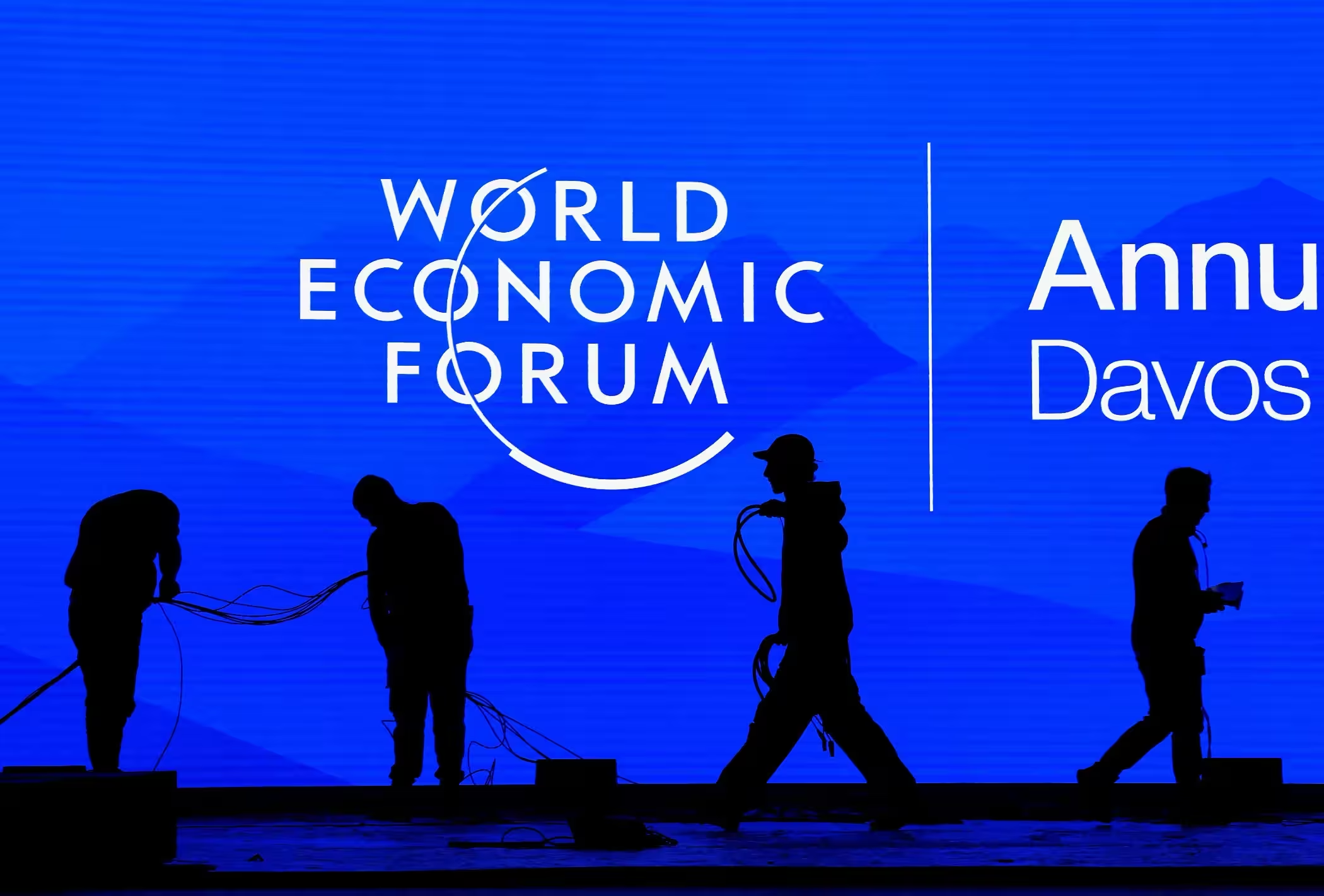
Davos, 2026
Davos 2026 ends in an air of worried satisfaction. The leaders gathered in the small Grisons resort spoke of artificial intelligence as a historic turning point but also as a decisive test for educational systems already weakened. The consensus was clear. The challenge of the century is not only to regulate AI but to train enough brains to tame it and share its fruits.
AI Everywhere, Skills Nowhere
Throughout the week, figures served as a refrain. One job in four should change by 2030. Nearly 40 percent of current skills would be obsolete by then. AI and data-related positions remain at record shortage levels while millions of young people struggle to find their first professional experience. The same figures appeared in official reports, public panels and corridor discussions.
For large companies, AI is no longer an experiment but an obligation. Technology groups present at Davos reaffirmed quantified commitments to train more than one hundred million workers in digital and AI skills by 2030. The promise is ambitious. It is also defensive. Without massive upskilling, automation projects crash against the reality on the ground. Leaders now openly acknowledge this.
Governments are not to be outdone. Several ministers of education and labor evoked the need to move from a lifelong diploma logic to a more modular continuous learning architecture. At Davos, a vocabulary once reserved for specialized circles — micro-certifications, skills-based learning, employer validation — burst into very well-attended round tables.
When School Meets the Algorithm
Beyond declarations of principle, the 2026 edition stood out for the density of spaces devoted to education. On the heights of Davos, the Education House brought together foundations and school networks for a tight critique of current systems. One of the common threads was simple: schools have taught students to pass exams in a stable world. They must now learn to form citizens capable of judging systems they do not entirely control.
Discussions focused less on the integration of digital gadgets than on the architecture of the educational experience. Participants pleaded for programs that combine data science and ethics, understanding of AI models and ability to contest their results. International network leaders insisted on the need to involve employers from the design of pathways in order to close the persistent gap between classroom and labor market.
In another corner of town, the Rosenberg House proposed a very concrete version of this ambition. This Swiss establishment, which proclaimed itself the first school to hold house at Davos, entrusted the programming of its sessions to teenagers. They presented a Humanix qualification mixing human, digital and technological literacies, a youth manifesto on AI, as well as a charter for responsible use of generative systems. Demonstrations ranged from climate gardens to quadruped robots used as pedagogical laboratories.
The exercise was as much symbolic as laboratory. Yet it signals an evolution. Youth is no longer only invited to testify but to co-write the rules of the game. The presence of academic and museum partners around these initiatives suggested that certain ideas might travel well beyond the Alps.
The Augmented Worker Remains to Be Invented
For companies gathered at Davos, the promise of AI remains double. On one side, the prospect of increased productivity through automation of repetitive tasks. On the other, the necessity of rethinking jobs around human-machine collaboration. In several pavilions devoted to AI, leaders admitted that the most promising projects often fail for lack of skills or team buy-in.
Sessions dedicated to vocational training converged toward one conclusion. The future of work will be summed up neither by machine learning engineers nor by low-cost workers replaceable at will. Most functions will require a mix of technical skills and properly human capabilities. In certain debates, experts proposed a symbolic ratio: approximately half of a job's requirements would now concern the relationship with technologies. The other half would fall under cognitive and social skills that algorithms cannot reproduce.
This vision found particular echo in a panel organized by a technology group on AI-augmented education. The discussion focused on adaptive platforms, personalization of pathways and the ability to train at scale. Speakers, from educational publishing, youth employment and the academic world, agreed that technology can accelerate learning but does not solve the political question. Who finances transitions for mid-career workers? Who guarantees that tools also serve those furthest from employment?
The Small Events That Made the Difference
If the large pavilions held the spotlight, the more intimate workshops often produced the most concrete exchanges. At the House of Switzerland, a lunch on transatlantic talent strategies dissected the Swiss dual apprenticeship model. Participants noted how this dead-end-free system enables exceptional mobility and resilience in the face of technological disruptions. American representatives were actively seeking to transpose these ideas at scale.
At the AI House, technical workshops on aligning AI with human values brought together researchers and public decision-makers. Debates focused on precise questions: how to calibrate models so they preserve cultural plurality; how to evaluate the potential loss of human agency in the face of increasingly autonomous systems. These closed sessions produced orientation notes intended for governments.
The Villars Institute organized a two-hour workshop on the IncuVersity Initiative. Ten young fellows from varied sectors confronted their experiences with heads of AI labs and manufacturing. The observation was unanimous. The paradoxical experience — hyper-qualified young people without a first entry door — is worsening with the automation of junior positions. The proposed solution: intergenerational incubators mixing experienced mentors and emerging startups.
At Wisdom House, coaching for nonprofit organizations on AI attracted some forty NGO leaders. The workshop proposed concrete tools for integrating AI into their operations while maintaining their social mission. Demonstrations on the ethical use of chatbots for distance education aroused keen interest.
Even the Climate Hub Davos, focused on regeneration, reserved a daily slot for green skills. These 90-minute workshops trained participants in practical tools for a regenerative economy. Participants learned to use digital twins for sustainable agricultural training or AI simulations to anticipate climate impacts on supply chains.
The Educational Gap Also Widens in the AI Era
Conversations on AI at Davos often began with the promise of democratizing knowledge. They quickly ran into the reality of the digital divide. A report on youth presented on the margins of the Forum recalled that nearly 70 percent of young people worldwide remain confined to the informal economy or poorly paid jobs. At the same time, a relatively small elite accesses the best technical training and international networks necessary to take advantage of the ongoing revolution.
Conscious of the polarization risk, organizers of several UN initiatives highlighted programs targeting developing countries. A coalition devoted to AI skills was announced to coordinate efforts of large companies and international institutions and avoid fragmentation of training offers. The ambition is to create a common infrastructure that would allow a worker from Africa or Eastern Europe to have their skills recognized on several labor markets.
This interoperability logic also extends to content. Participants from the Middle East or Africa insisted on the necessity of systems that respect local languages and cultures rather than imposing models designed for English-speaking audiences. Discussions around multilingual and culturally adaptive AIs illustrated the tension between global scale and local relevance.
A Pedagogy of Resilience
In the background of technical debates and quantified commitments, a more diffuse theme ran through Davos. Societies are not only preparing workers for new tasks. They are forming citizens called to live in an environment saturated with algorithms, climatic uncertainties and geopolitical pressures. The notion of resilience became a keyword not only for supply chains but also for educational pathways.
The most interesting initiatives do not merely transmit technical skills. They strive to develop the capacity to learn to learn, to work with different interlocutors and to arbitrate between efficiency and values. Some pedagogues recalled that history is full of technologies that first served to concentrate power before being domesticated by democratic counter-powers. AI will be no exception. But the delay between invention and regulation could be much shorter than in the past.
Davos produced its usual share of promises: coalitions to train millions of people, reconversion plans for vulnerable workers, commitments in favor of responsible AI. Skeptics will note that the same actors have sometimes been slow to correct the effects of previous digital waves. Yet the lucidity about the scale of the challenge seems greater than at the beginnings of the generative AI craze.
On the station platform leaving the valley, pavilion slogans dissipate quickly. What will remain of Davos 2026 will depend less on resolutions signed in salons than on the capacity of governments, companies and educational institutions to transform these commitments into genuinely open learning systems. Otherwise, AI will not be the engine of shared prosperity but the mirror of inequalities that we chose to ignore.
American Dominance
Davos 2026 marks the World Economic Forum's shift from a sanctuary of responsible capitalism toward an assumed platform of power capitalism, where the MAGA agenda and technological sovereignty have supplanted climate, diversity and global morality. By trading its ideals for direct access to American power, the WEF may have regained its centrality, at the price of becoming a premium service for the moment's dominators rather than a place of vision.
Events cited in the article
Main official events and pavilions:
- AI House Davos (Promenade 67, January 19-23): 40+ panels on human-AI alignment
- Education House (Hotel Schatzalp, January 20, 3-6pm): Redesign of educational systems
- Rosenberg House (Schatzalp, January 19-24): Sessions led by teenagers, Humanix qualification
- HCLTech Pavilion (Promenade 66, January 21, 11:30am): Panel "Advancing Education with AI"
- House of Switzerland (Nordside, January 20, 11:45am): Lunch on Swiss dual apprenticeship
Workshops and small events:
- Villars Institute IncuVersity workshop (Schatzalp, January 20, 2h): 10 fellows on youth employment
- Wisdom House NGO coaching (Davos primary school, daily): Ethical AI for nonprofits
- Climate Hub green skills workshops (daily, 90 min): Agricultural digital twins
- AI House closed technical workshops: Cultural alignment of AI models
Other mentions:
- Imagination in Action AI Summit (The Dome, January 21)
- Open Forum Davos "Swipe Left on Reality" (January 21, 9:30am)
- Global Shapers Youth Pulse 2026 launch
- AI Skills Coalition (prototype launch)
What Mentivis Actually Does
Mentivis is not a consulting firm that leaves with a PowerPoint. It is an educational transformation operator that stays until it works.
The Uncompromising Diagnosis
Before talking about AI, we ask the uncomfortable questions. Who really decides in your institution? What are the real blockages behind the speeches? What resources do you actually have, not those you wish you had? We do not validate your intuitions. We map your constraints.
Operational Arbitration
You cannot do everything. We help you renounce intelligently. Which programs to transform first? Which skills to target for which real career prospects? Which tools to adopt without creating toxic dependency? We decide with you, not for you.
Pedagogical Translation
Between "we must train in AI" and a course that works, there is a chasm. We cross it. We design devices adapted to your teachers as they are, to your students as they arrive, to your constraints as they exist. No turnkey solutions. Pedagogical craftsmanship.
Long-Term Support
Transformation is not decreed on a Tuesday morning. We stay alongside your teams during the critical phase: when the first resistances appear, when tools do not work as planned, when adjustments must be made without losing course. We train your trainers. We equip your decision-makers. We build with you the governance you lack.
Credibility That Counts
We do not sell you badges. We help you produce graduates who know how to do, immediately, visibly. Projects that recruiters recognize. Skills that your business partners validate. Credibility built on proof, not on certifications.
In one sentence
**Mentivis transforms "we should train in AI" into "here is exactly what our learners can do upon graduation."
And we get there because we do not work on your ambitions. We work on your real capacities for change.