Education-as-a-Service: Reinventing Professional Training in the Age of Accelerated Obsolescence
By Jean-Marc Benetti
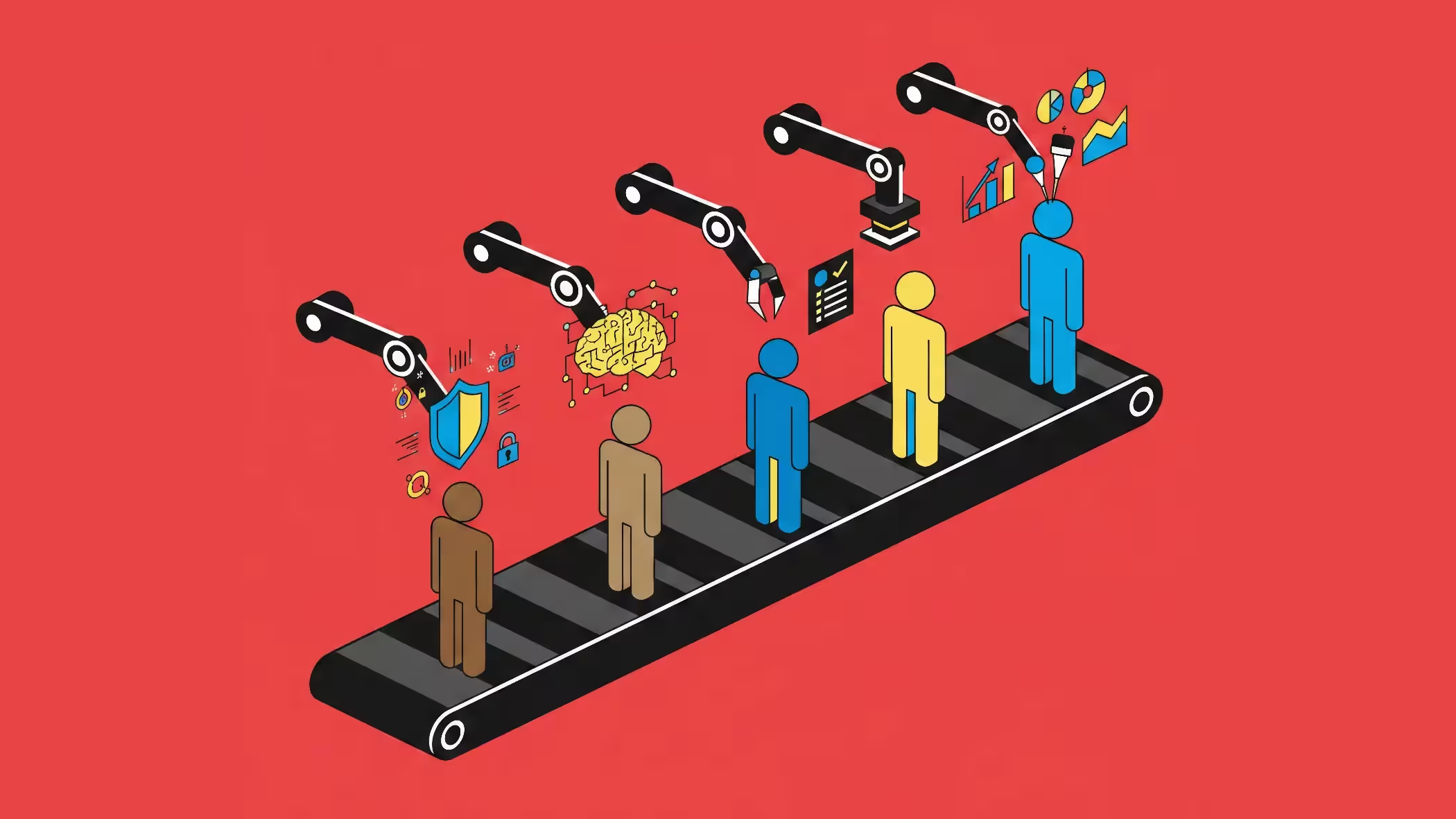
When training becomes a permanent infrastructure rather than a one-off event, that is EaaS.
Engineers gather for a technical sharing session. This week, one of them presents the new features of React 19, freshly released. Next week, it will be a colleague's turn to expose his experiments with the latest language models. No one speaks of Education-as-a-Service. Yet that is exactly what has been happening here for fifteen years.
This reality, technology companies know it well: according to a recent study, 80% of tech organization leaders believe that continuing training represents the most effective means of filling skills gaps. What is changing today is not so much the practice as its industrialization. Education-as-a-Service proposes to package in a standardized commercial model what sectors with high technological velocity have always done in an artisanal manner.
The Half-Life of Skills: A Measurable Reality
The figures speak for themselves. According to IBM, the most cutting-edge technical skills now have a half-life of barely 2.5 years, meaning their relevance diminishes by half in less than three years. This acceleration is not marketing fantasy. It corresponds to a structural transformation of the digital economy, where innovation cycles shorten while technical complexity intensifies.
For digital professionals, this reality is nothing new. A developer who mastered Angular in 2015 knows full well that React and then Vue.js came to redraw the front-end development landscape. A cybersecurity specialist trained on the threats of the 2010s understands that the emergence of ransomware, then AI-powered attacks, has rendered part of their arsenal obsolete. Permanent adaptation is part of the job.
What is evolving is the way this adaptation is organized. Where it once relied on individual initiative (conferences, reading, personal experimentation) or ad hoc internal programs, it is gradually becoming institutionalized through dedicated infrastructures.
What Schools Have Known for a Long Time
Ask the pedagogical managers of major computer engineering schools, and you will hear a remarkably coherent discourse. The technical content taught will likely be outdated before the class even obtains its diploma. What truly matters is the method: learning to learn, mastering the fundamentals that survive fads, developing an intellectual adaptability capacity.
This approach has for decades constituted institutions' pragmatic response to the impossibility of staying synchronized with industry. Programming languages change, frameworks evolve, but the underlying principles (algorithms, data structures, software architectures) remain relatively stable. Schools therefore train on invariants, hoping that their graduates will then know how to navigate the rest.
Education-as-a-Service does not contradict this philosophy. It extends it into the professional world by proposing an infrastructure to maintain this adaptability capacity active throughout a career. The democratization of education through technology has fundamentally transformed how knowledge is accessed, delivered and consumed, with personalized learning experiences facilitated by adaptive algorithms.
Ordinary Practices That Are Industrializing
In sectors where technological velocity imposes its law, high-performing organizations have never waited for a marketing acronym to validate their practices. Google created its own internal university as early as the 2000s. Amazon now invests more than $1.2 billion in optional training programs to prepare its teams for robotic technologies and other advanced innovations. PwC launched a $3 billion continuing training program, accessible to all its employees via an application where they can assess their skills in AI, augmented reality and machine learning.
These devices are not the subject of thunderous press releases. They are part of basic operational hygiene, on the same level as infrastructure maintenance or software version management. When your competitive advantage rests on your teams' capacity to master technologies that did not exist eighteen months ago, permanent learning is not a luxury. It is a matter of survival.
The Subscription Model: Economic Pragmatism
What EaaS truly brings is expanded accessibility. The Education-as-a-Service model enables academic institutions and companies to use courses aligned with their needs without having to buy excess pedagogical resources that will not be implemented. For a fifty-person startup developing mobile applications, subscribing to a platform offering updated pathways on iOS and Android presents obvious interest. It outsources a recurring problem without mobilizing internal resources.
The subscription model transforms an unpredictable cost into a predictable charge. Institutions adopting EaaS benefit from reduced operational costs, better resource management and improved pedagogical results. This approach is part of a broader movement of tertiarization of support functions, where every process once managed internally becomes an outsourced service, accessible via the cloud.
Technology at the Service of Personalization
One of the major contributions of EaaS lies in its capacity to industrialize personalization. With Education-as-a-Service, clients expect continuous access to training, resources, support and updates, rather than one-off courses. Advanced platforms use artificial intelligence to adapt pathways according to individual gaps and progress.
This mass personalization solves an equation that has long been problematic: how to effectively train hundreds of people with heterogeneous profiles without mobilizing an army of trainers? AI does not replace human expertise, but it filters, guides and prepares the ground so that interaction moments are concentrated on real difficulties.
The flexibility of EaaS allows learners to study at their own pace, at the time and place they choose, giving students control and responsibility over their own learning. This learner-centered approach relies on constructivist theory, which suggests that humans generate knowledge and meaning from the interactions between their experiences and their ideas.
Implementation Challenges
Despite these advantages, the adoption of EaaS raises significant organizational challenges. According to a recent study, 71% of employees want to update their skills more frequently, and 80% would like their companies to invest more in continuing training. Yet only 28% of organizations plan to invest in training programs over the next two to three years.
This gap reveals a fundamental tension. Moving from an event-based training logic to a flow-based training logic requires a profound cultural change. Managers must accept that their teams regularly devote time to learning, not as a distraction but as a productive investment.
The technological challenge also exists. EaaS relies on robust digital infrastructure: reliable connections, adequate terminals, integration with existing systems. For organizations still entangled in aging architectures, the technical prerequisite can constitute an obstacle.
Measuring Impact: The Correlation Challenge
The question of impact measurement remains partially unresolved. EaaS platforms provide detailed dashboards on completion rates and assessment scores. But the causal link between these metrics and actual operational performance improvement remains sometimes tenuous.
LinkedIn research shows that companies with strong learning cultures experience higher retention rates, more internal mobility and a healthier management pipeline. 69% of respondents believe that continuing training has been beneficial for their work performance.
These positive correlations validate the approach, even if they do not entirely resolve the impact measurement question. The challenge for the coming years will be to refine these mechanisms to establish robust links between training and operational results.
Learning in the Flow of Work
The common 70/20/10 framework suggests that employees acquire 70% of their skills on the job, 20% from other people, and 10% through formal learning. The future of training does not consist in adding more sessions on top of work, but in reimagining work itself as fundamentally formative.
In this new paradigm, learning is not a separate activity, but an integral part of the work experience, personalized, continuous and directly linked to operational results. The most innovative organizations already integrate learning into daily processes, creating environments where training and production naturally merge.
An Ecosystem Under Construction
Collaboration between employers, educators and workers remains essential in the face of accelerating technological disruption. By embracing continuous learning and innovation, organizations and individuals can adapt to change.
The rise of Education-as-a-Service is not a simple fad. It responds to a structural transformation: in an economy where competitive advantage no longer resides in access to information but in the speed of adaptation to its evolution, training can no longer be a one-off event. It becomes a continuous process, a permanent infrastructure.
The companies that will succeed are those that know how to create environments where learning naturally integrates into daily professional life. EaaS provides the technical tools for this mutation. It remains for organizations to adapt their cultures, their processes and their performance indicators. Because the real challenge of EaaS is not technological. It is human and organizational.
Mentivis
Transformation is not decreed, it is operated. Mentivis does not leave you with a PowerPoint, but with a system that works. From confronting your real constraints to training your teams, we ensure pedagogical engineering and change management support.
EaaS transforms a vague strategic intention into a promise kept to students: proven skills, not just badges. We work on your real capacity to change.